ID: 0579
DATE: 2020/03/13
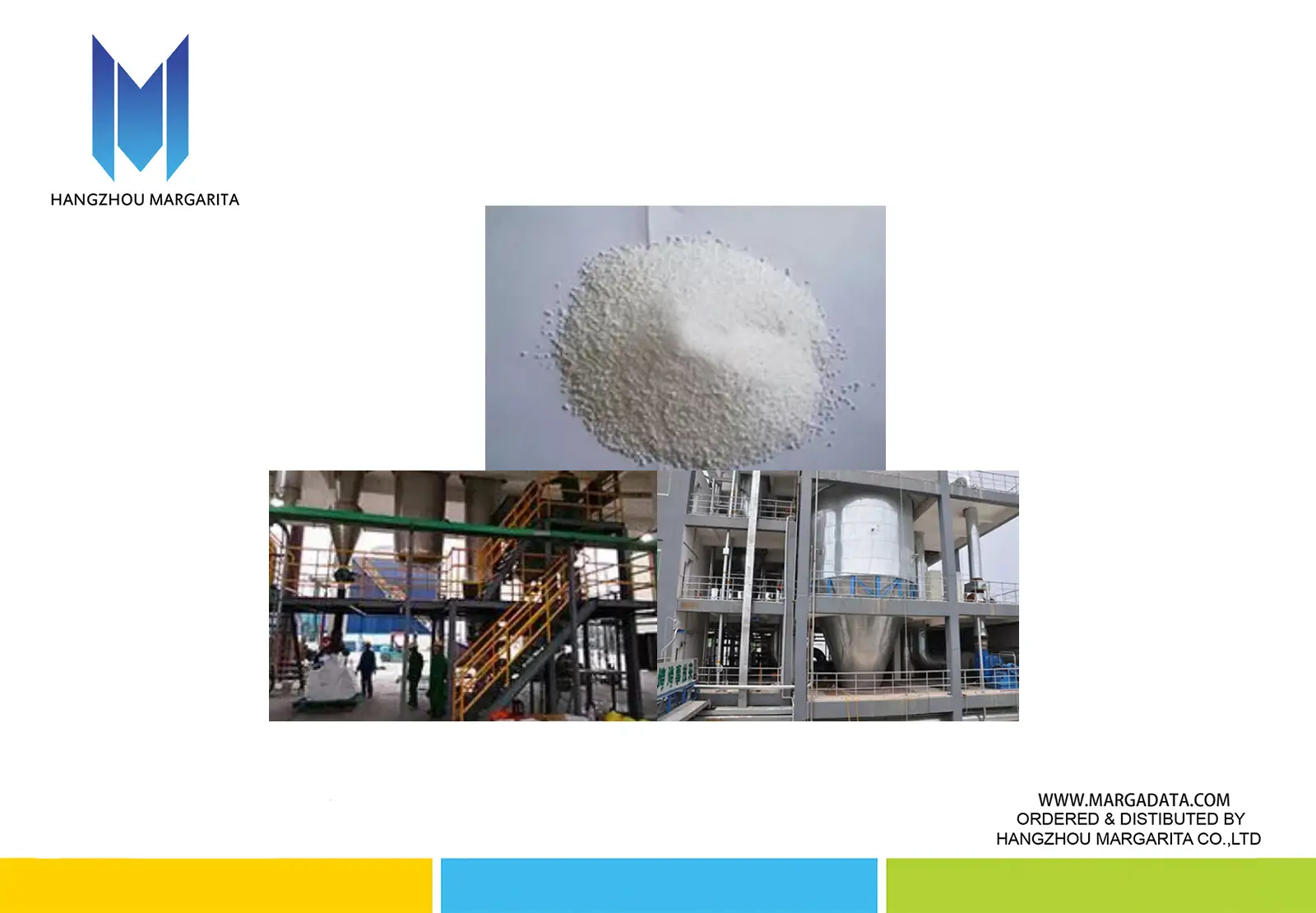
GOODS NAME: Paraformaldehyde Plant
HS CODE:
DETAILS:
Introduction of paraformaldehyde properties
Paraformaldehyde referred to as PF, is a kind of white powder or granular solid. It is an important linear polymer in chemistry. The formula is HO·(CH2O)n·H, density 1.39 (water = 1), melting point 120-170 ℃, flash point 71 ℃, the ignition temperature 300-410 ℃, combustion heat 510 kj/mol, and generate heat 177 kj/mol, and the vapor pressure 0.19 kPa / 25 ℃, dust lower explosive limit is 40 g/m3. Paraformaldehyde will slowly decompose into formaldehyde gas at normal temperature, and form formaldehyde solution after depolymerization, so it has the general characteristics of formaldehyde. Paraformaldehyde is a mixture of 8-100 molecular units of formaldehyde – Polyoxymethylene glycol HO(CH2O)nH.
Paraformaldehyde has two types: low polymerized paraformaldehyde and solid paraformaldehyde, mainly by the degree of polymerization of formaldehyde – chain number of formaldehyde molecule n, low polymerized paraformaldehyde n < 12, water soluble, fully depolymerized, loose product with uniform particles, is the ideal raw material of pure formaldehyde as well as good substitute industrial formaldehyde, it has great potential in development.
| Molecular Formula | (CH2O)n |
|---|---|
| Chemical structure |  |
| Synonym | Polyoxymethylene |
| CAS No | 30525-89-4 |
| EINECS No | 200-001-8 |
| INCI name | Paraformaldehyde |
Chemical and Physical Properties:
| Appearance | White prilled solid |
|---|---|
| Odour | Formaldehyde odour |
| Density (g/mL,20℃) | 1.45 |
| Relative Density (g/mL ,Air=1) | 1.03 |
| Melting Point (oC) | 163-165 |
| Boiling Point (oC) | Uncertainty |
| Dielectric Constant (25oC) | Uncertainty |
| Flash Point (open up, oC) | 70 |
| Explosion Limits (Vol %) | Uncertainty |
| Uncertainty | |
| Solubility in Water | Unsoluble in wate, Slightly solublein cool water, soluble in dilute acid and dilute alkalis |
Paraformaldehyde production process
At present, there are two production processes of paraformaldehyde: one is vacuum rake dryer process; the other is spray dryer process.
Rake dryer processThe raw formaldehyde is firstly dehydrated for concentration to increase from 37% to 65%. Then it is sent to the rake dryer for further dehydration and drying until the powder is discharged. The whole dehydration process is operated under negative pressure. The evaporative condensate containing 10-15% dilute formaldehyde returns to formaldehyde section, which is configured as 37% formaldehyde for export or to produce methylal and hexamine. This process is a batch operation, each feed to rake dryer is 4-5m3, drying time is 4-6 hours, the processing cycle is long with low output, and product is powder block.
Spray dryer processFormaldehyde is repeatedly concentrated under the vacuum conditions to increase the concentration up to 85%, and then pumped into spray dryer. Concentrated formaldehyde is ejected from the nozzle and condensed into granular paraformaldehyde solid. This process will produce low polymerized formaldehyde molecules chain with continuous production process, short time concentrated formaldehyde spray granulation and the product has good water-solubility.
Paraformaldehyde is mainly used in
( 1 ) Farm chemical: synthesis of ethyl oxalamide, butyl oxalamine and glyphosate
( 2 ) Medicine: produce vitamin A
( 3 ) Coating: synthetic high-grade automotive paint
( 4 ) Resin: used in synthetic resin (such as ion exchange resin, melamine resin, etc.), of which 70-80% is used in the production of pesticide synthetic glyphosate herbicide. In the resin industry, paraformaldehyde is used to replace 37% of industrial formaldehyde to produce phenolic resin, which can not only produce high-quality thermoplastic and thermosetting phenolic resin, but also greatly reduce the discharge of waste water and material consumption by more than 10%.